5D BIM Services: What Actually Makes Cost Estimates Accurate - Not Just Faster
Eminent BIM TeamNov 06, 20261 min read73 words
What separates a real 5D BIM workflow from a one-time Excel export - and why estimate accuracy depends on LOD, not software.
5D BIM Services: What Actually Makes Cost Estimates Accurate - Not Just Faster
5D BIM services tie a 3D building model directly to schedule and cost data, so a design change updates quantities and budget automatically instead of through a separate manual takeoff. Done properly, that linkage pulls estimate accuracy into the AACE Class 2–3 range - roughly ±10% to ±20% - well before construction starts, against the ±30% or wider swing typical of conceptual manual estimates.
Frequently Asked Questions
No. Software extracts quantities; it doesn’t guarantee they’re right. Accuracy depends on modeling discipline - consistent wall joins, no double-counted elements, the right LOD for the estimate class you’re targeting. The common claim that “if you’ve modeled it, the quantities are accurate” is the single biggest misconception in this space.
Not necessarily. The coordination payoff scales with system complexity, not just square footage - a smaller building with dense MEP routing can benefit as much as a larger, simpler one.
LOD 300 supports a Class 3 budget estimate. For Class 2 accuracy - the level most bid/tender decisions need - LOD 350 is the realistic floor.
The underlying model doesn’t change, but the cost-reporting convention does: AACE classification in the US, RICS New Rules of Measurement in the UK, and local QS practice across the GCC. A deliverable built for one market often needs re-formatting, not re-modeling, for another.
Locking an estimate before the model has reached the LOD that estimate class requires - essentially asking for Class 2 numbers from Class 4 modeling.
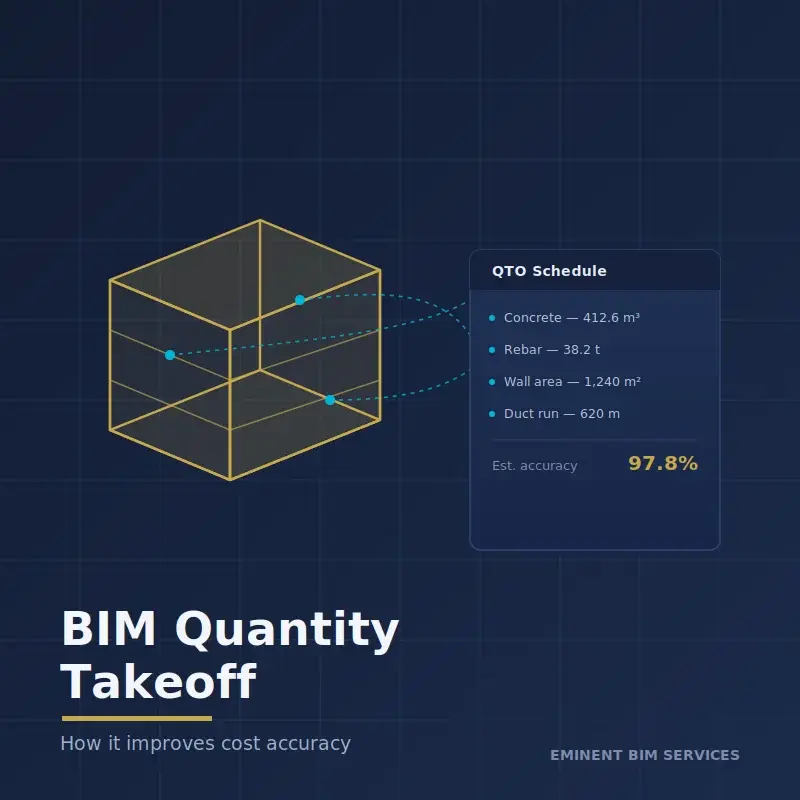
Comparative studies put BIM-based takeoff around 95% accuracy versus under 89% for manual methods on the same structure, though accuracy varies by element type.
Per square foot for defined scope, hourly for coordination-heavy work, or monthly retainer for ongoing projects - rarely a flat all-in fee.
Ask which AACE (or regional equivalent) estimate class they’re targeting, what LOD the model will reach before cost-loading, and whether they can show a past project’s estimated-vs-actual variance.