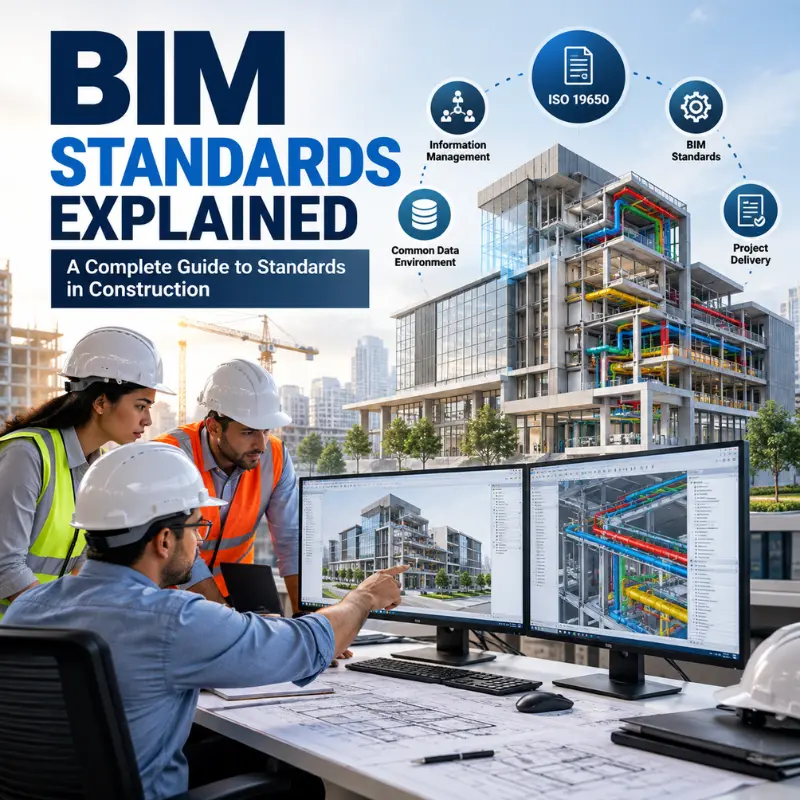
- BIM standards are the documented rules, frameworks, and protocols that govern how building information is created, organized, exchanged, and managed across a construction project. At the international level, the ISO 19650 series is the primary reference. Alongside it sit national standards, employer-specific requirements, and project-level documents like BIM Execution Plans - all working together to make sure every team member, regardless of location or software, is handling information the same way.
Key Takeaways
- ISO 19650 is a six-part international standard governing BIM information management across the full asset lifecycle - Parts 1, 2, and 3 are currently under revision (Draft International Standard published March–June 2026).
- A BIM Execution Plan (BEP) is not optional on serious projects - it is the contractual document that defines how a team will deliver against the client's information requirements.
- The Common Data Environment (CDE) is a workflow, not just a software platform. Getting the workflow right matters more than the tool chosen.
- LOD 300 and LOD 350 represent different coordination milestones - confusing them causes real coordination failures on-site.
- ISO 19650 is mandatory on UK public sector projects and increasingly expected by major private developers in the UAE, Saudi Arabia, and Australia.
- Naming conventions are a coordination problem, not a filing problem. Bad names break automated checking, clash workflows, and model audits.
What Are BIM Standards?
BIM standards are the agreed-upon rules for how digital building information is created, structured, shared, and archived throughout a project. They cover everything from file naming to model accuracy requirements to how information flows between parties.
The confusion most people encounter is that "BIM standards" is not one thing - it is a layered stack. At the top sits the international framework (ISO 19650). Below it are national implementations (the UK BIM Framework, NBIMS-US in the United States, the ACA BIM guidelines in Australia). Below those are employer information requirements set by clients, and at the project level, the BIM Execution Plan translates all of the above into specific rules for a specific project team.
Understanding which layer you are dealing with at any point is the first practical skill a BIM coordinator needs. Most disputes about "BIM standards compliance" happen because someone is applying a national-level guideline to a clause that was only ever an international principle - not a hard requirement.
Why Are BIM Standards Important in Construction?
Construction involves dozens of organizations - architects, structural engineers, MEP consultants, contractors, subcontractors, specialist suppliers - producing thousands of files over years. Without agreed standards, every team produces information in a different format, with different naming, different levels of detail, stored in different places. By the time coordination starts, merging those models becomes an archaeological exercise.
More concretely: projects that implement BIM standards through a properly executed BEP and CDE consistently see fewer clashes discovered on-site rather than in the model. The cost of resolving a clash in a Navisworks federated model is a fraction of the cost of resolving the same clash after steel is erected or mechanical systems are installed.
There is also a compliance dimension. On UK government projects, ISO 19650 alignment is a procurement requirement. In Dubai, the Dubai BIM Mandate has required BIM on buildings over 40 stories (and certain other asset types) since 2014 - and the information management requirements that come with it draw directly on ISO 19650 principles. In Saudi Arabia, NEOM and Saudi Aramco both maintain internal BIM standards that outsourced delivery partners are expected to follow. Ignoring BIM standardization is not just an efficiency loss - it is a disqualification risk.
Different Types of BIM Standards
BIM standards operate at three distinct levels, and most practitioners need to be familiar with all three.
- International Standards establish the overarching framework. ISO 19650 is the primary one. It does not mandate software or prescribe modelling minutiae - it defines the process of information management and the roles involved.
- National Standards and Frameworks interpret and supplement the international standard for local context. The UK BIM Framework provides detailed tendering and appointment guidance aligned to ISO 19650. In the United States, NBIMS-US V4 is widely referenced, though the US market has historically been more fragmented in its standard adoption than the UK. Australia's ACA BIM guidelines address local procurement and contract conditions. In the Middle East, both the UAE and Saudi Arabia have developed sovereign BIM strategies that reference ISO 19650 while adding project-type and sector-specific requirements.
- Project-Level Standards are what every team member actually works from day-to-day: the BIM Execution Plan, the project's naming convention, the agreed CDE, the model breakdown structure. These live documents govern the daily reality of BIM delivery on a specific job.
Understanding ISO 19650 and Information Management
ISO 19650 is the international standard that defines how information should be managed on construction and infrastructure projects using BIM. It is not a modelling guide. It will not tell you which Revit workset to use or how detailed your pipe systems need to be. What it defines is the organizational framework: who is responsible for information, when information should be produced, and how it should be checked, reviewed, and shared.
The standard has six parts. Most practitioners only encounter Parts 1 and 2, but knowing what the others govern avoids misunderstandings about scope.
- Concepts and Principles: The vocabulary and model of information management that everything else builds on. Read this once at the start of any ISO 19650 implementation.
- Delivery Phase: This is the one used daily on live projects. Appointments, information requirements, production and delivery of information containers, the CDE workflow.
- Operational Phase: Information management once the asset is in use - the asset management and facilities management side. Often overlooked by project teams who hand over the model and walk away.
- Information Exchange: Governs the formats and protocols for exchanging information between parties.
- Security: A security-minded approach to BIM information management - increasingly relevant as project data becomes a target.
- Health and Safety: Published in 2025, this covers health and safety information management using BIM - the newest addition to the series.