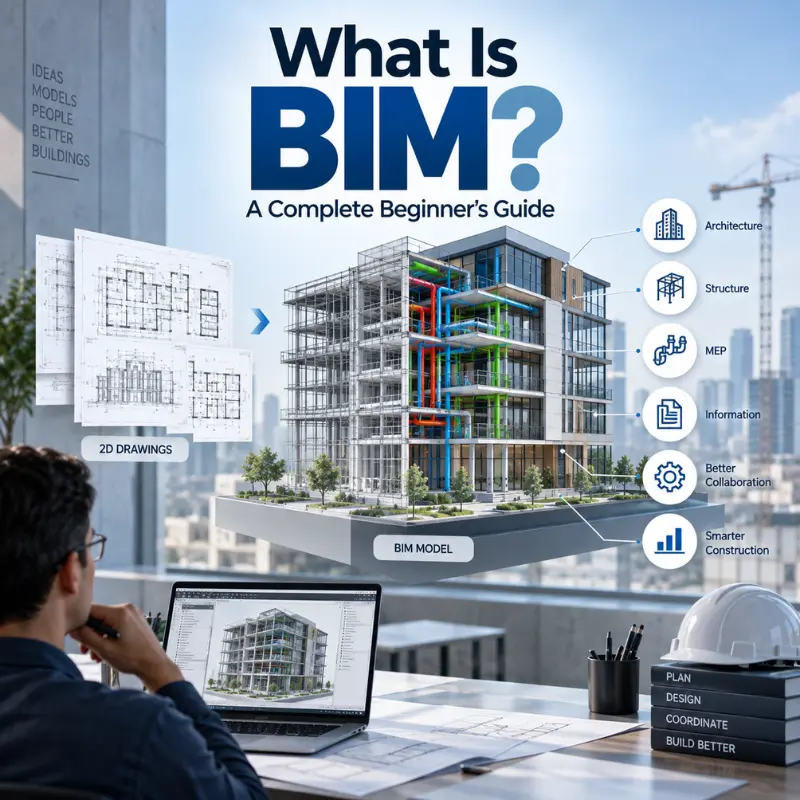
If your projects still run on scattered PDFs, clashing drawings, and phone calls to clarify what "as-built" actually means, BIM implementation is the fix nobody warned you would take this much planning.
Getting it right isn't about buying software. It's about changing how your team thinks about a building before a single brick gets laid.
I've sat through enough BIM rollouts, some smooth and some genuinely painful, to know that most companies fail not because the technology is hard, but because they skip the boring groundwork. This guide walks through what actually works.
What BIM Implementation Really Means
BIM implementation is the process of moving your company from 2D drawings and disconnected files to a coordinated 3D model that carries data, not just geometry.
Walls know what they're made of. Ducts know their size. Clashes show up on screen instead of on site.
That sounds simple written down. In practice, it touches your contracts, your staffing, your software licenses, and how your PM talks to your site engineer.
A proper BIM implementation plan treats all of that as one connected system, not a software rollout bolted onto old habits.
Audit Where You Actually Stand
- Before buying a single license, figure out your starting point. Most firms overestimate their readiness.
- Which projects still rely purely on 2D CAD?
- Does your team have any Revit, Navisworks, or ArchiCAD exposure at all?
- Do clients or government tenders already demand ISO 19650 compliance?
- What's your current clash rate on site, roughly, in terms of rework hours per month?
I worked with a mid-sized contractor in Delhi who assumed they were 60% BIM read because two engineers had taken a Revit course. Turned out zero live projects used coordinated models.
The gap between training and actual workflow adoption is where most implementation budgets get wasted.
Define Your BIM Implementation Strategy
This is the part everyone rushes, and it's the part that determines whether year two looks better or worse than year one.
Your strategy needs to answer three questions clearly.
- What Level of Development (LOD) does each discipline need, and at which project stage?
- Who owns model federation, meaning who actually merges architecture, structure, and MEP into one checked file?
- And what's your data drop schedule, since clients increasingly expect deliverables tied to RIBA or ISO 19650 stage gates, not just "send it when it's done."
Build the BIM Execution Plan (BEP)
The BEP is your project-specific rulebook. It's not a formality for the tender submission drawer.
A working BEP covers file naming conventions, coordinate systems, model authoring responsibilities by discipline, clash detection frequency, and who signs off on federated models before issue.
For a 400,000+ square foot institutional project we supported recently, the BEP alone ran close to 40 pages, separate from the lighter client-facing summary.
That level of detail felt excessive to the client at first. By month four, when three disciplines needed to coordinate a mechanical shaft revision overnight, everyone was glad the naming convention and version control rules were already locked.
Choose Software Based on Workflow, Not Marketing
Revit dominates for a reason, but it isn't the only piece you need. Navisworks handles clash detection and 4D sequencing.
Dynamo automates repetitive modeling tasks that would otherwise eat hundreds of billable hours. BIM 360 or Autodesk Construction Cloud (ACC) keeps everyone working off the same live model.
Don't buy the whole stack on day one. Match tools to the discipline pain points you identified in your audit.
A structural-heavy firm needs different priorities than an MEP-heavy one.
Train People, Not Just Assign Software
This is where BIM adoption in construction quietly stalls. Companies license the software, run a two-day crash course, and expect fluency. It doesn't work that way.
Real competency needs layered training:
- Software fundamentals (modeling, families, views)
- Discipline-specific modeling standards tied to your BEP
- Coordination workflows, including how to read and resolve clash reports
- Dynamo or scripting basics for the team members who'll automate recurring tasks
Budget for at least 1 Years of applied practice before expecting production-quality models from a team that's new to BIM. Anyone who promises faster is selling you something.
Run a Pilot Project First
Don't roll BIM implementation out across every live project simultaneously. Pick one mid-complexity project, ideally one where the client is already asking for coordinated models, and run it as a controlled pilot.
Track clash counts before and after model federation. Track RFI volume. Track how many site disputes trace back to drawing conflicts.
These numbers become your internal case for scaling up, and they're far more convincing to skeptical site managers than any vendor slide deck.
Standardize, Then Scale
Once the pilot proves out, codify what worked into a firm-wide BIM implementation process. Template your family libraries.
Lock your naming conventions across projects, not just within one. Set a baseline LOD matrix that project teams customize rather than reinvent from scratch each time.
This is also the point where many companies start looking at BIM implementation services from an outside consultancy, either to fill skill gaps permanently or to get through the first two or three complex projects without slowing delivery.
There's no shame in that. Even firms with strong in-house teams outsource peak-load coordination work regularly.
Common Mistakes That Derail Implementation
- A few patterns show up again and again:
- Treating BIM as an IT purchase instead of a process change
- Skipping the BEP because "the team already knows what to do"
- Letting model ownership sit with whoever's least busy that week
- Ignoring MEP coordination until structure is nearly locked, which guarantees rework
None of these are exotic problems. They're just the ones nobody budgets time to prevent.
Getting BIM Implementation Right, for Good
BIM implementation isn't a one-quarter project you finish and move past. It's a shift in how your company plans, coordinates, and delivers buildings, and it keeps evolving as your projects get more complex.
Firms that treat it as infrastructure, not a trend, end up with fewer disputes, tighter schedules, and clients who come back.
Ready to move from planning to execution?
Eminent BIM Services helps construction companies build and scale their BIM implementation- from BEP development and clash-free model coordination to Revit and Dynamo training for in-house teams.
Whether you need a pilot project run right or ongoing BIM support across architecture, structure, and MEP, our team plugs in where you need us most.