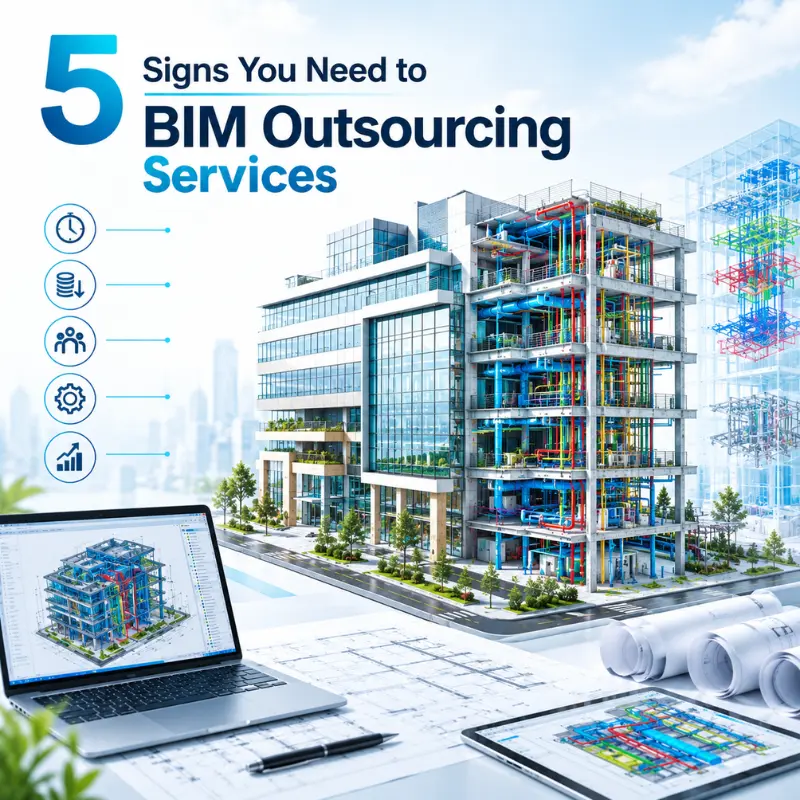
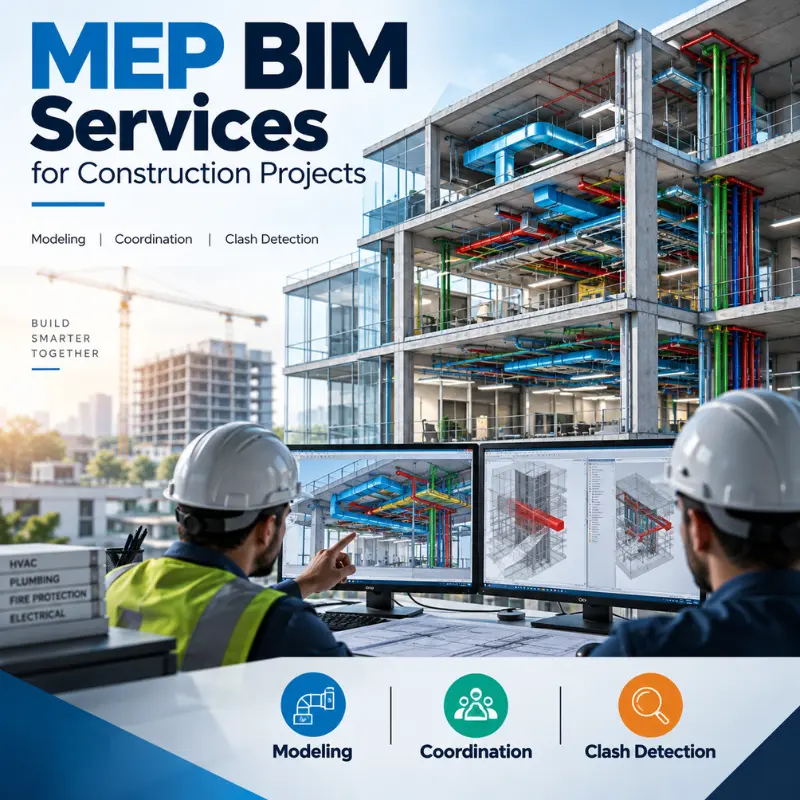
BIM consulting services save time and money by catching design clashes before construction starts, generating accurate quantity takeoffs directly from the model, and cutting RFIs and rework.
Firms working with an experienced BIM Consulting Company usually see fewer change orders, faster shop drawing turnaround, and 20-30% less time spent on fabrication detailing.
Eminent BIM Services has coordinated models across structural, MEP, and rebar detailing workflows for over a decade. The pattern repeats on almost every project.
Teams that model correctly before breaking ground spend far less fixing problems after. Every single time.
I've sat in enough coordination meetings to know the moment a project starts bleeding money. It's usually not a big dramatic failure. It's a clash between a duct run and a structural beam that nobody caught until the steel was already on site.
This is exactly why firms are leaning harder on bim consulting services - not as a nice-to-have, but as the thing standing between a smooth build and a six-figure change order.
The bigger time sink most firms don't talk about is rework caused by outdated drawing sets. When architects, structural teams, and rebar detailers are all working off slightly different versions of a model, someone eventually builds the wrong thing.
A good BIM Consultancy keeps everyone pulling from a single coordinated model, which sounds simple but changes the entire rhythm of a project.
Here's where the hours actually get recovered:
- Quantity takeoffs pulled directly from the model instead of manually counted from 2D sheets
- Shop drawings generated faster because the geometry already exists in 3D
- RFIs dropping sharply once the model resolves ambiguity before it reaches the field
- Scheduling tied to 4D sequencing so crews aren't standing around waiting on decisions
- Fabrication files exported straight from the model for HVAC, plumbing, and electrical contractors
What Is BIM Consulting?
BIM consulting is a professional service where an outside team builds, manages, or coordinates 3D building models on behalf of architecture, engineering, and construction firms.
That's the short version. It covers clash detection, quantity takeoffs, model federation, and 4D scheduling support too.
Most firms bring in BIM consultants for one of two reasons. Either they don't have the in-house modeling capacity, or they need overflow support during peak periods and don't want to hire full-time staff for a temporary spike in work.
How Does BIM Consulting Reduce Construction Costs?
BIM consulting reduces costs by preventing errors before they reach the job site, where fixes cost far more. A clash caught in the model might run $50-$100 in coordination time.
The same clash discovered in the field, after materials are already installed, can run into the thousands.
On a mid-rise mixed-use project Eminent BIM Services supported in 2025, clash detection flagged 214 conflicts during pre-construction coordination. Not a rounded estimate 214, pulled straight from the coordination log.
Resolving them in the model took about three weeks. The GC's own estimate put field-based fixes for a similar number of clashes at five to six additional weeks of schedule delay. That gap is the whole argument for BIM in one sentence.
Cost savings tend to show up in four places:
- Fewer change orders - conflicts resolved before pricing locks in
- Reduced rework - trades build from one coordinated model instead of five conflicting drawing sets
- Lower material waste - accurate takeoffs stop over-ordering
- Leaner staffing - one model replaces hours of manual cross-checking between disciplines
How Does BIM Consulting Save Time?
It compresses work that used to happen in sequence design, detailing, takeoff, fabrication prep into a single workflow built around one live model.
No more waiting on updated 2D sheets that may or may not reflect last week's revisions.
Fabrication is where the time savings show up most clearly. Rebar detailing companies and HVAC contractors working from a coordinated model typically cut detailing time by close to 30%, because dimensions and clearances are already resolved instead of re-derived from architectural drawings by hand.
Which Is Better: In-House BIM Team or Outsourced BIM Consulting Firm?
An outsourced BIM Consulting Firm is generally faster and lower-risk for firms without a mature internal BIM department.
An in-house team makes more sense when the modeling need is continuous and high-volume. So the real question isn't company size it's project volume.
Most design-build companies and GCs start with an outsourced BIM Consultancy for one pilot project. Then they decide whether internal capacity is worth building, based on what actually happened on that job not on a sales pitch.
Why Do Firms Use BIM Implementation Services?
Because switching from 2D, or from unmanaged 3D modeling, to a fully coordinated BIM process takes planning most internal teams don't have time to do themselves.
It's not that firms can't figure it out. They just can't figure it out while also running live projects.
A phased rollout works better than a full switch overnight. Start with one discipline structural or MEP, usually and measure results within a single project cycle before going further.
That one step lowers the risk that stops most firms from adopting BIM Management Services in the first place.
Who Benefits Most From BIM Consulting Solutions?
Almost every discipline touching design, detailing, or construction coordination sees measurable impact. Not just architects, even though that's who most of the marketing around this topic targets.
- Architecture firms - faster design iteration and coordination
- Structural consultants - early clash resolution with MEP and architectural systems
- MEP consultants - clash-free duct, pipe, and conduit routing
- Rebar detailing companies - dimensions pulled straight from coordinated structural models
- Fabrication companies - shop-ready files generated directly from the model
- General contractors - fewer field surprises, tighter schedules
- Real estate developers - budgets that hold because change orders don't pile up late
- HVAC, plumbing, electrical, and fire protection contractors - clash-free installation paths before crews arrive on site
There's a smaller but growing group worth mentioning: BIM consultants with overflow work. These are firms that already understand BIM but hit capacity limits during busy seasons.
Partnering with an outsourced team during peak periods isn't a sign of weakness. It's smarter than turning down projects or burning out an internal team trying to hit deadlines.
Eminent BIM Services has taken on overflow modeling for firms in exactly this position, and the pattern is consistent- the work gets done faster because the outsourced team isn't starting from zero on process, they're just adding capacity to an already-functioning system.
BIM consulting services aren't magic. A bad model built quickly is still a bad model, and it'll cost you later regardless of what software made it. But when the process is done properly, with real coordination discipline and people who know what they're doing, the time and cost savings aren't theoretical.
They show up in fewer RFIs, tighter schedules, and change orders that never get written in the first place.
So here's the real question worth asking before your next project kicks off: how many hours did your last job lose to problems that were only discovered after the concrete was already poured?