ISO 19650 Global BIM ConsultancyMon – Sat: 24/7 Support
BIM Services5 Signs You Need to Outsource BIM Modeling Services
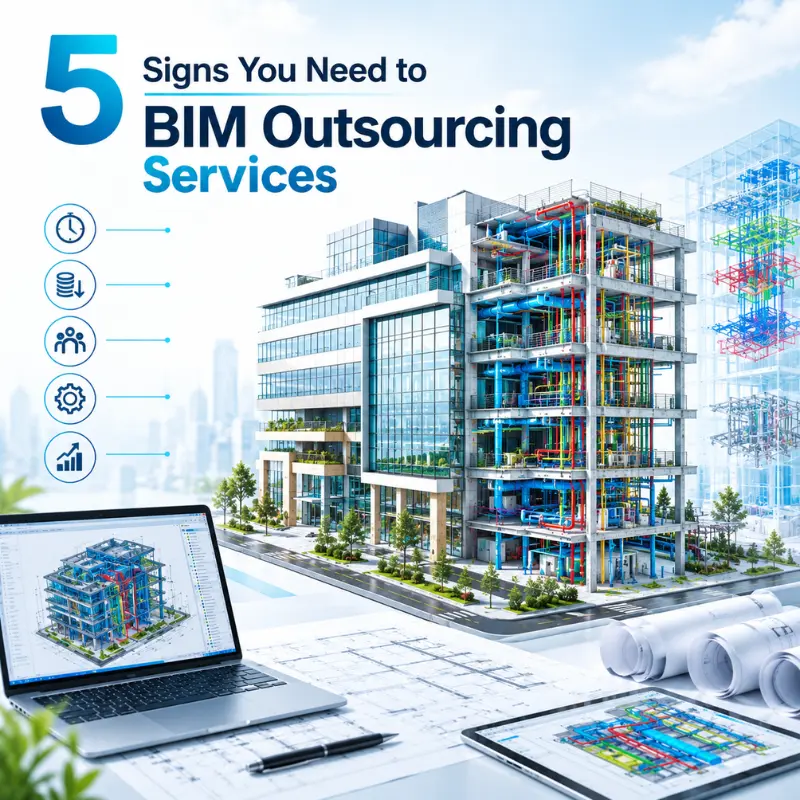
5 Signs You Need to BIM Outsourcing Services
Eminent BIM TeamOct 01, 20261 min read170 words
If your team is missing deadlines, declining projects, or struggling with ISO 19650 compliance, you may have a production model problem not a staffing one. Here are five clear signs it is time to bim outsourcing services.
If your team is missing deadlines, turning down projects, or struggling with BIM mandates you cannot currently meet, you may not have a staffing problem you have a production model problem.
Outsourcing BIM modeling services is not a fallback. For hundreds of AEC firms across the USA, UK, and the Gulf, it is the only way to stay competitive without carrying the overhead of a full in-house BIM department.
Key takeaways
Consistent deadline pressure and overtime on BIM deliverables is a signal, not a temporary phase.
BIM outsourcing market demand is real: the global BIM outsourcing segment was valued at approximately USD 4.6 billion in 2025, projected to reach USD 9.8 billion by 2032 (est., per 2025 market research).
Compliance with ISO 19650 and regional BIM mandates has become a contract requirement- not a differentiator.
The true cost of an in-house BIM seat (software, hardware, training, idle time) typically exceeds what firms budget for it.
A hybrid model - one in-house BIM Manager owning standards, an external team handling production volume - consistently outperforms both extremes.
Frequently Asked Questions
Understaffing and a structural capacity gap look similar on the surface but have different fixes. If hiring one or two people would genuinely resolve your BIM delivery issues for the foreseeable future and your project pipeline justifies the ongoing overhead, hiring is probably the right answer. If your pipeline fluctuates significantly between projects, or if your BIM requirements involve disciplines your team does not specialise in, outsourcing is the more rational model.
This objection comes up constantly and is worth addressing directly. A BIM model is a production deliverable - geometry, data, coordination, documentation. Code compliance and design interpretation are the architect's and engineer's responsibility, not the modeller's. A well-briefed outsourced team working from your BEP and project specifications does not need to know the Building Regulations Part B to produce a coordinated Revit model to your standards. That said, experienced providers who work regularly in your target market will be familiar with common client requirements, Uniclass naming, UK NBS conventions, or AIA CAD standards. Ask specifically about market experience before engaging.
It is a manageable risk, not an inherent one. Most reputable BIM outsourcing providers operate under NDAs, use project-specific access credentials on shared CDE platforms (BIM 360, ACC, or Procore), and do not retain model files beyond project completion. The same protocols you use for any external consultant or subcontractor apply here. The risk is not unique to offshore providers.
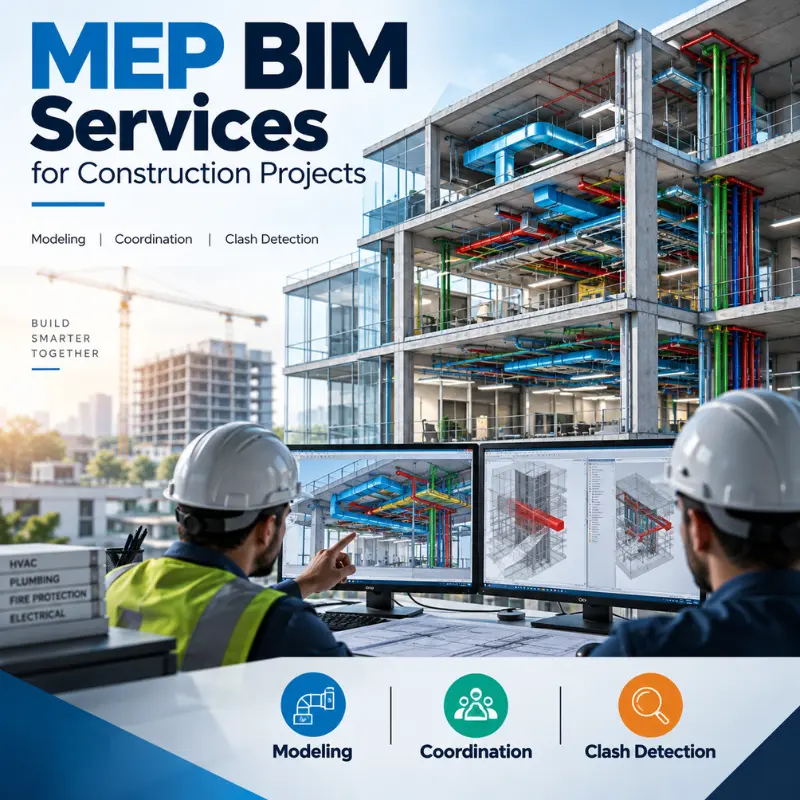
Production-heavy, repeatable tasks with clear deliverable definitions outsource most cleanly: 3D BIM modeling (Arch, Structure, MEP), clash detection and coordination, shop drawing production, Revit family creation, Scan-to-BIM, as-built documentation, and QTO from models. Tasks that require direct client communication, design decision-making, or local regulatory interpretation are better kept in-house.
Rates vary significantly by geography, discipline, and deliverable complexity. Indicatively (est.): architectural BIM modeling with a qualified Revit technician in India or Eastern Europe typically runs USD 15–35 per hour, versus USD 55–90 per hour for equivalent in-house staff in the UK or USA when total employment costs are included. Per-project pricing is also common for defined scopes. The total cost advantage depends heavily on your project mix it is worth getting a scoped quotation rather than comparing hourly rates in isolation.
The honest answer: it works at almost any size, but the value is most obvious at two extremes. Small practices (2–10 people) often cannot justify full-time BIM staff and benefit enormously from on-demand outsourcing. Larger practices (30+ people) benefit from outsourcing overflow and specialist tasks while maintaining a core internal team. The middle ground 10 to 30 people is where the build-vs-buy decision is genuinely close and worth modelling on actual project economics.